Showing posts with label cat diabetes. Show all posts

Sunday, January 13, 2019

Pippin is almost 16!

My friend recently found out that his cat has diabetes.  I kind of helped him along figuring it out because his cat was just peeing all over his house.  I told him there has to be something wrong, they don't just do that. So I brought over my glucose reader and sure enough.. the cat's glucose was super high.  This made me look back at this blog and see that I've been updating it a few times a year since 2012!  Wow. Pippin is now 4 months away from 16 years old.  He has really slowed down.  My mom gave us a heated bed that her cat isn't using at Thanksgiving and we brought it home and put a blanket and his bed on it and now he pretty much just stays there all day.  He loves it in his old age.

He had also been seeming to slow down on his eating though, so my husband and I decided to get his teeth cleaned.  I was very nervous about it since he's so old.  I really actually didn't want to do it but knew if the vet wasn't comfortable with doing it then they wouldn't. So I took him in last week and he did well.  His glucose was the worst thing that day.  They told me not to give him a shot in the morning so I didn't, but of course by the time he got there he was at 477.  So the vet gave him a shot and then had to watch him all day.  Otherwise, he had no teeth pulled.  She did say his gums weren't great but that's expected with old age.  The cost was $520!  Getting a pet's teeth cleaned is one of the most expensive things I swear.  And this was WITHOUT any teeth pulled.  We did use Care Credit, which is a credit card you can use for humans or animals that usually has a limited time where you can make payments without interest.  I think usually a vet office's terms are 6 months.  So you have to pay it in 6 months and if you don't you get a huge interest rate on your money.  If you don't have the money you may want to look into this for your pet but be sure you can pay the money back in the time allotted for no interest. My sister right now is struggling with her cat... she really wants to clean her cat's teeth but it's so expensive and she doesn't have the money for it. 

I learned another thing this week that I should've learned years ago but NO vet ever told me.  Apparently, you have to do what is called calibrating to your diabetes glucose reader. UMMMM WHAT!  Why was I never told this before.  My friend who's cat I mentioned above is an RN. So since he just ordered a reader he mentioned to me that readers need to be calibrated to make sure that they are still reading the blood glucose correctly over time.  WHAT THE! I've been using the same reader for like 10 years.  I'm really disappointed no one mentioned this.  I ordered the fluid from Amazon today for my Easy Reader to calibrate it. It was only $9. I'm not sure exactly how to do it yet but I'm sure there are Youtube videos out there plus my friend has done it several times at work so I'm going to have him come over to help me do it.  Anyways... even after having diabetic cats for at least 10 years I am still learning new things. 

Hoping your diabetic cats are doing well 


Sunday, September 30, 2018

Neuropathy in Cats

Hello all.  Thought I would stop in and write up a little update on Pippin.  He is actually doing well. As he's getting older he's been not really wanting to eat his dry food so we put out wet food and dry food for him.  One time a vet told me that for a diabetic cat any type of wet food was ok for them.  So it doesn't have to be specifically for diabetes. I don't know if his teeth are hurting him but since he's 15 I'm a little nervous about having his teeth cleaned again.  He had them done when he was 13 I think and he didn't do too well afterwards so I'm putting it off unless it seems necessary.

He's started to walk on his hocks a little which is called Neuropathy. Neuropathy is nerve pain that diabetics get in their limbs.   I took him into the vet and she didn't seem that concerned and said we just need to get him regulated.  He is regulated though so then she told me though eventually it can become irreversible. I came home though and did a lot of research on the internet about it and found some diabetic cat threads where people were talking about giving their cats B12 for Neuropathy.  I found people were using Zobaline (specifically for cats) so I emailed my vet and asked about it.  She said she doesn't tell people to use it because it's not proven to help cats with Neuropathy but told me that if I wanted to try it I could.  Of course I ordered it.  I think it's helping him but my husband says he looks the same.  HAHA!  So ...  I'm going to keep him on it forever since it doesn't hurt and it's just a supplement and since it could be helping him why not? 

As Pippin gets older I start to think about him passing away.  People always ask me... will you get another cat?  I am really not sure.  It's going to be a long long time before I do. I just can't replace my cats like some people.  I just feel like it's.. not right to go out and just get a "new" cat.  Maybe it's because I don't have kids and Merry and Pippin are like kids to me.  Anyways... hopefully I still at least have two more years with Pippin.


Sunday, April 29, 2018

New Vet... again

Well.... everything with Pippin is going good.  For the first time ever I recently completely forgot to give Pippin his shot.  I've never forgotten.  Sometimes, I've been late.  But this time I remembered in the middle of the night at like 12:30 am and just let it go because my husband gives him his shot at 4:00 am.  So I just thought it was best to keep the next shot at 4 am and get back on track from there.  I felt terrible. After that I set a reminder on my phone at 5:30 PM just incase I forget again.

I recently sent Pippin's glucose numbers to my vet office (not that anyone there is really checking up on him, or paying attention).  After sending the numbers over I did get an email back from the veterinarian I use stating that she was leaving and going back into emergency care.  I'm so disappointed in this. I know that the people at the office are like whatever because it's one of those offices where they have like 5 or 6 vets.  I hate that.  I kept staying with the dame Dr whenever I go in for an appointment and when emailing in.  I did ask her for a recommendation in the office of someone who could be my go to but she never answered me back.  I hate to change vets and go to an office with one Dr because I'd have to pay $100 some bucks for that first initial visit and explain and go over everything about Pippin all over again. So I'll just stick with this vet and deal with it.  I'm really surprised though that I lost another vet.  If the Dr was going to a different practice I would follow her there but since she's going into emergency I can't.  I do miss my old vet office.  They would check in with how Pippin was doing at least once a month and review his glucose numbers with me... the new vet office (though I've been there like 2 years now) just doesn't take as much interest.

Pippin is 15 now.  He sleeps soooo much.  I can tell that he is starting to feel his age.  We recently moved into a new house and it's taken him a little while to adjust.  He used to love to sit outside at the old house and this house it's taking a little longer.  He has finally started sitting out on the patio just for a little while. He never sits in the windows... he just likes to mostly be in his bed or sitting on a chair with me. It's hard to see my boy age.  His diabetes is doing really well though and that's what's important.

Wednesday, January 17, 2018

Diabetic Cats- Cat Bed

There is nothing worse then having a diabetic cat and finding you left the insulin out.  NOTHING. The knowledge that you just wasted $100 on a vial of Prozinc is awful.   I came home from going out to dinner tonight to find that the insulin was still on the counter.  Luckily it was only out two hours in the dark so I'm hoping that it is still a good vial.  The only way to know is to take glucose measurements tomorrow and just hope they go down.  It's the first time we have only left the insulin out a few hours rather then 12 hours so I'm really hoping it's good.  Plus it was still foggy inside the liquid which I guess is a sign it's still good. I've looked all over the internet whether or not Prozinc can be left out for 2 hours and most say yes.  I saw several comments saying that it's OK to leave it out even for 12 hours.  I have found that this is false.  Anytime we've left insulin out for 12 hours and checked glucose on our cats their glucose numbers are super high and it's obvious the insulin wasn't working anymore. 

I recently had to waste money taking Pippin into the vet.  The new vet wanted to "see" him (get $60 and blood work) since his glucose was a little higher then usual.  My old vet would just adjust insulin amounts... so that kind of sucked.  Then she wanted to put him on an antibiotic just incase but I didn't pick that up because he's fine just needed a insulin adjustment. So complicated.

We sold our house so we've been staying with a friend until we get a new one.  Pippin has done well.  He has the run of two bedrooms and one bathroom.  My friend has two cats of his own and Pippin just doesn't want to mingle with them.  So he's enjoying his time upstairs in his own territory. Though I know he's ready to get into his own house again. 

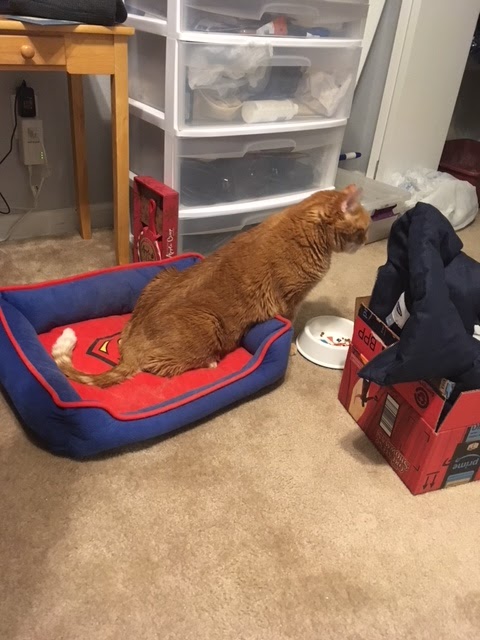
We have still been buying our needles and food online.  Much cheaper then the store.  Diabetes hasn't got any easier but Pippin is still doing well and hopefully lives another 5 years. We bought him a new bed finally.  All these years he and Merry slept in these tiny circle beds we bought them when we first adopted them.  I bought them a bigger bed once before but they completely ignored it.  I was then in Petsmart and saw a superhero section (for dogs) and there was a Superman bed! I bought it and he ignored it at first.  For a long time actually and now I can't get him out.  Since we are staying in our friend's house we had Pippin's bed and food next to each other.  This picture shows him not even bothering to get out of bed to eat.  He's just leaning over to his food bowl.. so lazy!!


Wednesday, August 23, 2017

New Carpet and other news

Hello all. I haven't updated on Pippin for a while.  Which is always a good thing.  In May over the holiday my husband accidentally left Pippin's Prozinc (insulin) out for about 3-4 hours.  Just in that time the insulin went bad.  Of course it was a Saturday morning.  So we gave him his normal shot Saturday night and his insulin stayed high.  So we realized right away that the insulin went bad.  Well... of course it was a holiday weekend so the vet office wasn't open on Monday. I was very worried about the glucose numbers so Monday morning we went ahead and called one of the local emergency vets who said they had insulin and that we would just have to come in and pay $100 for the vet appointment and they would sell us insulin because they had a full pharmacy.  So I drove Pippin all the way out to the vet.  We got totally wrong information.  I get there and I tell them where his numbers were sitting at (which if I remember correctly was about 450). I say he is on Prozinc.  The vet tech was like... well I've never heard of that, they only have human insulin.  UGHHHH!  I didn't want to switch Pippin's insulin which I thought would be worse then having him on no insulin.  Plus, human insulin doesn't really work on cats.  I then asked if maybe they had vetsulin and she said she would check.  She was gone for a very long time.  Finally, a totally different person comes in and says they just don't think there is anything they can do for me. Annoying.  Why when we called did they act like they could help???  They didn't charge me anything and I left.

So Tuesday I called my normal vet and explained what was going on and why I needed to come pick up insulin right then and there.  They were nice.  I got up there an hour later when they told me to come and it wasn't ready, but I told them I had to wait because he really needed it.  So he got back on his insulin again and has been fine ever since.

We are about to sell our house and buy a new one, so we installed new carpet everywhere in the house.  Prior to having it installed we personally pulled up all the areas where the cats had peed. There is no better time to get under that carpet.  If your cats pee a lot in certain spots it will stink no matter how much you shampoo that carpet.  So we pulled up the carpet and put down Kilz in all these spots. The carpet installers still threw out the carpet we pulled up.  The new carpet is amazing and smells amazing! HAHAH!  Diabetic cats will pee a lot before you discover they are diabetic and will keep peeing in the spots that smell like their pee.  Also, the year before Merry passed away he couldn't make it down to the basement so having the little box in the living room pretty much stopped both cats from peeing anywhere else.


I'm nervous about selling the house with a cat.  I plan on taking him with me every time the house gets shown.  I don't want to leave him here with strangers coming in and out.  We'll see how that adventure goes and I'll update here with any advice for those of you who might also be trying to sell a house with a kitty living there.


Tuesday, April 25, 2017

Updates.. dental, diabetes, artwork

It's been a while since I posted.  Since Merry passed away actually.  I just never really felt up to it. I thought I'd give some updates on Pippin.  He's doing fantastic now.  At first when Merry was gone he would meow for him.  Especially when he went out to sit on the deck (they aren't outdoor cats, only in door but can go on the deck).  Even writing this post and thinking about Merry is sad.  Right after it happened I found myself getting two scoops of food, or hearing his nails tapping on the floor, every now and then I hear him meow.  I still haven't removed his picture from my Facebook's profile picture.  I just can't take it down yet.  It's like he's really gone, or I've really decided that I'm over him.  I don't know when I'll take down his picture if ever. It's been very difficult.  Actually, actress Felicia Day just posted something about this on her Facebook:

SERIOUS QUESTION:
I have a picture of my dog Cubby on my phone lock screen. He passed away 2 years ago next month. I have a baby now and want to put her on the lock screen, but I feel INCREDIBLY GUILTY about removing his little face so I can't make myself do it. It feels disloyal, like I won't see him every day to remind me of how much I loved him and maybe I'll forget him. How do I overcome the guilt?!?! IS THERE ANOTHER SOLUTION?!?!

I know how she feels.  Though I don't have children. Anyways... Pippin was doing well till a few weeks ago.  On a Sunday I saw something by his food bowl but honestly I thought it was trash.  Like a garlic clove or something.  I got around to picking it up on Tuesday and thought it was so odd.  When I first looked at it I thought maybe one of his claws came out.  I handed it to my husband and was like... "what is this!  I think he lost his nail! "  My husband was like.. "um .. this is a tooth."  So I grabbed it and sure enough it was Pippin's FANG! Oh my God! I felt so bad.  I immediately called the vet. She put him on antibiotics and a week later he got his teeth cleaned.  It had only been 14 months since his last cleaning so I have no idea why this tooth fell out!

Tooth I found! 
And... when he went in to have his teeth cleaned (this is a new vet.. see previous posts) it was taking a long time for them to call with an update.  So I called up there and they told me there were having a tough time but everything was fine.  I come to find out that the previous vet LEFT the roots in for 3 teeth that they had pulled at his last teeth cleaning.  ARE YOU KIDDING ME.  The rear right molar was giving the new vet a hard time.  The root had rotted and slipped under his jaw bone into an area where I guess blood and tissue gather and she had to get it out of that.  I am pretty furious about this but what can I do.  He was hurting for a while and had to go on pain meds for two weeks.  He's great now and really spunky.  It's so hard to know if pet's mouth's are hurting.  I felt so bad when all this happened. 

Pippin's diabetes is really doing great.  He's on 4 units of Prozinc twice a day, his steroid at night, and after Merry passed we decided to start giving Pippin Cosequin to help with his bones.  We've also done a lot of research (of course this is after years and years of paying high prices at the vet) and now order his prescription cat food through Petsmart.  We set up auto refills and so we get an additional 15% off the food.  Needles are the same.  Insulin and the steroid cost the same from the vet so we still get those there.  

I did have one of my favorite cat artists do a portrait of my cats for me.  Apofiss does amazing artwork.. especially of cats. They rarely do commissions so I was so lucky to be able to get one.  PLUS lucky that he would do both cats.  I told him if he couldn't do Merry and Pippin then I wasn't interested in the commission.  Can't have one cat without the other.  He did a great job.  I sent him several pictures of them for him to use as a reference and this was the result:


Be sure to check out Apofiss' work! 

Thursday, November 10, 2016

Skin Cancer

I haven't posted before about my cat Merry's skin cancer.  It started at the beginning of the year. Around April. I noticed a scratch on his nose.  About 6 weeks later it wouldn't heal and was becoming circular. I took him into the vet.  The vet gave me some meds to put on it but said it's probably skin cancer. The way we would know is if the medicine didn't get rid of the cut then it was for sure skin cancer.  He said really there is no reason to take a sample and send it in since I had already decided that I wasn't going to do chemo or radiation.  I also refuse to have Merry's nose removed.  Those are the only options if a cat has skin cancer on their nose. I have no idea why he got skin cancer.  He's not an outdoor cat so there hasn't been that much sun exposure on his nose. When we went to the new vet she felt the same way.  Merry is now 16 years old. Here are pictures from when we first discovered it:


Now that it is November it has progressed a lot since this then.  Most of the year it has only been a superficial wound.  Meaning it was really just eating away the top layer.  I think that now it is finally actually eating through the skin.  Now we must make the painful decision when to call it.  He is walking very slow with a pronounced limp.  Honestly I'm not sure if he will make it past the end of the year. But we'll see.  I try to look at him and see if he still has quality of life.

Pippin my other cat is actually doing pretty fantastic health wise.  We had a scare about a month ago though.  One morning we gave the cats double shots.  It was a scary day.  I got up and gave the cats shots and then my husband got up and gave them shots again.  We had to take a lot of glucose curves that day. The lowest reading Merry had was 54.  After that though his glucose went up.  Just goes to show communication is very important.  The many years we have been giving these cats shots that was only the first time for that mix up to happen.

We will be taking care of another cat come January.  My sister is unfortunately going through a terrible divorce.  Her husband has left here with nothing.  Of course she will fight for child support but she has asked me to take her little kitty.  Toast is about 9 years old. I am of course going to help my sister out and bring Toast to my house.  I am going to do everything in my power to make sure Toast doesn't get diabetes.

Well.... hope all your fur babies are doing amazing


Wednesday, June 15, 2016

Cat Paw Prints Framed

My cats are my world.  I would never abandon them.. even if I was moving, they were sick (see previous posts), or for any reason really.  They are getting older so I've been thinking more about ways to enjoy them and be able to remember them.  Sooooo I started thinking about making their paw prints into cute art.  I looked all over the internet to find out how.  Pinterest and blogs all gave some great advice.  All the posts I saw were for dogs and the paw prints always looked perfect.  That certainly was not the case.


I got my supplies together first.  I ran by IKEA the other day and picked up some frames (I can't find the frames on their website... they have them in stores only $2.99) and then I went ahead and grabbed some popsicle prints that were .99 cents that are supposed to go in the 2.99 frames (found here). Honestly those .99 cent prints were way cheaper then any card board stock I could find in a store.  I then went by Michaels and bought some paint and stickers.  Then paint was $1.69 Crayola Brand Washable Kids' Paint. You want your paint to be washable and you want it to be nontoxic.  Believe me!  The paint will get everywhere (so you want it washable) and your cat will lick their paws even after you wash their paws so you want to make sure it is nontoxic.  I did see some people use acrylic paint but I was worried about using that. The stickers were in the scrapbook section and were $4.99 but I used the Michaels' app and got 50% off those.  I have horrible handwriting so that's why I used stickers.  If you have nice handwriting maybe paint their names on the print.

Supplies:
Frames
Strong Paper for the art work (card stock)
Paint
Cat
Paper towels
Scratch Paper to practice


Get ready to begin.  Corral your cat into the location you want to do this.  Don't do it on carpet. I brought in a tray thinking I was going to have them stand on it to get the print but I found it easier to just have Merry and Pippin lay down and hold the paper up to their foot once the paint is on it.  Also... originally I had painted his entire foot. Don't do this.  Try to use a paint brush and only get the paint on the paw pads and none on the fur. If you do get a lot of it on their fur you may end up with a blob of paint rather then a paw print.  There were five of the popsicle prints from IKEA so I only had five shots at getting a good print so I practiced some.

Merry
Trying out a few paw prints on scratch paper

Chose your favorite paw print

Pippin wants out of the bathroom!

After you push their paws onto the paper get their paws washed off right away.  Not only so the paint doesn't get everywhere, but also so they don't have a chance to lick their paws. I have no idea how people get a perfect paw print.  I did read some people were using ink pads but I like the look of paint better.  The advice for this project I can give you is have fun and don't worry about perfection.  I do believe that cat paws are going to be harder then dog paws because they are smaller.  Luckily my cats are short hair too because cats with long fur in their paws might be messy to wash off!


Sunday, May 22, 2016

Homemade Cat Box

So you may have read on my previous post that Merry has arthritis and it's getting advanced.  So he does have a harder time getting up and down stairs to use the litter box and was even having a few accidents.  I knew I needed to move a litter box up into the living room but really hated the idea because litter gets everywhere.  One night my husband went out in the garage and created a box he had seen online.  I wanted to wait and post about it after we sanded it and painted it but we still haven't got around to that so ... I'll post what it looks like now.  It's still pretty.. but I would like it to be painted white.


It's easy to clean out and really makes a big difference for Merry going to the bathroom.  He hasn't had an accident since we built it.  I had Merry on only a narcotic (torbegesie) for his arthritis but since it's getting worse I asked the vet to try something different.  He is now on Metacam and was also on Tramadol for pain (Tramadol comes in little tubes and you wipe it in their ears).  Well, turns out that now Tramadol is under control from the FDA so I have to get a prescription and take it to a pharmacy?  That doesn't totally make sense to me because isn't a vet office technically also a pharmacy for pets?  Anyways... it wasn't really working so I was just about to switch him back to Torbegesie.  So when I went to the vet and asked to switch apparently Torbegesie has been on back order for 6 months.  I was like... what are cats getting for pain then if neither one of these meds are available at the vet and they just kind of shrugged.  Annoying.  A new vet takes over the practice tomorrow (see previous posts).  I am kind of excited about it because maybe they will be able to help me get Merry on something better for the pain.

I had to find another cat sitter.  Sigh.  The second one I found is now moving.  So the third one is also from my vet office (this is my third vet tech who will be a cat sitter). I am really comfortable having them sit my cats incase something bad happens. My other cat Pippin has been doing really well.  We did just do a glucose curve and he was a little high so we upped his Prozinc 2 units.  It's scary though since he had that major drop in glucose last summer.

If you ever wonder how to make a cat box like this for your little box be sure to check out Pinterest.  They have a lot of ideas.

Edit:  We added another entryway for us to be able to clean the litter.  It makes a big difference to not have to take everything off of the top every time we scoop.  I tried to get an up-close shot of the hinges being used. Now I just need to paint this thing!


Saturday, August 2, 2014

Updates

Hello!  I haven't updated in a while since things have been going well.  We went on a vacation recently which is always hard when you have a diabetic cat (or cats in my case).  Really it has come to the point where asking friends is a hassle. After my cats having diabetes for two years asking for a favor to have people come over has really just run it's course.  No one wants to do it anymore.  Maybe if my parents or sibling lived here it would be different since they are family, but we only have friends who live around us.  So then we had to go on the hunt to actually hire someone (though we did offer friends the same amount of money it would cost to board them).  Luckily we were able to find someone at our vet who also goes to people's homes to take are of their cats.

What is really great about this is that the vet allows this.  It's not actually through the vet at all, they have their own boarding in the building.  But they do allow the workers to tell people they would come to their house.  So nice. I really prefer keeping the cats at the house. AND since she works for the vet if anything bad happened or the cats looked sick she could either ask my vet or take them up to the vet. It wasn't cheap but I had piece of mind.

Then.. the night we got back, I completely forgot to give them shots.  I couldn't believe it.  The only reason why I even realized it was because the next morning my husband woke me up to ask what time they got their shots and I couldn't remember.  It dawned on me because I couldn't remember giving it to them.  Being on vacation 8 days I guess will do that.  I forgot to also set my alarm on my phone for the shots.  I felt terrible. I know they probably didn't feel good at all. Luckily, there were no seizures or deaths. Which is what I was afraid of. 

Soooo.. needless to say everything is back to normal.  Curves have been coming out good.  We will do another one next weekend.  Pippin is on 7 units Prozinc, 5mg Glipizide twice a day, 1 steroid in the evening. Merry is on 6 units of Prozinc, 4 units of Vetsulin, 5 mg Glipizide twice a day.

Sunday, February 16, 2014

Teeth Cleaning Success

If you read the previous post on the blog you know we weren't able to clean Merry's teeth last week.  He wasn't able to go under because he couldn't breath on his own.  So this week my vet tried again using a different anesthesia.  It was successful this time. Though it turned out quite expensive.  When Merry went in the previous week my vet could tell he has a lose tooth, but that was all she could really see at the time.  When I picked him up he had like 8 teeth pulled!  I did have his teeth cleaned in May 2012 so I didn't think it had been that long and then 2 years before that.  He has never had teeth pulled before now.  I don't know how they got so bad.  She did say that when a cat is diabetic their teeth will go bad... but that bad~!!  He was under anesthesia for 50 minutes and so she didn't take xrays because he was under so long.  Merry gets sooooo moody at the vet.  I had to go in the back and move him into his carrier.

The vet did say she wants to see him in two weeks but she can't even get near him.  I asked her how she would look at his mouth and she said from a distance.  Well I am not going to pay $50 for her to stand away from him and say he looks good.  I have been feeding him wet food for the week, and of course he is on all kinds of medication.  I am going to start softening his diabetic dry food so he can eat that from now on.  I think with all those teeth gone it's going to be too hard for him to eat normal hard food.  His eyes also wigged out the night after his dental.  One eye was fully dilated and the other was not.   I googled this and of course this is a major sign of stroke.  Luckily my vet will email after hours if you email her so I emailed her right away! She did say this was a symptom of coming down off morphine.  But it was still very scary.

Be sure to get your cat's teeth cleaned. I had NO idea this is how bad his teeth were.  I would've never know he was in pain.  His breath did stink real bad so that's how I knew it was time.  Plus my vet had 10% off this month for dentals so I saved a lot of money there too. 


Yellow teeth are the ones removed

Monday, February 3, 2014

Teeth Cleaning

Merry's breath has not smelled good lately and it's been about 1 1/2 years since the last time he had his teeth cleaned.  I think it's important to take care of your cat's teeth.  Imagine a painful mouth!  Cats can't tell you when their mouth hurts so I try to do it every now and then (I don't do it as often as recommended though). If your cat has bad breath though then it's time.  Most likely there is plaque stuck somewhere in their teeth.

He fasted during the night but since he is diabetic he had to have a little food this morning. No shot though, no food or water during the night.  After dropping him off I called and check on him a few hours later.  Turns out he couldn't breath on his own while he was gassed so my vet decided to not do it today.  She was able to get some plaque off some of his teeth, but went ahead and woke him back up.  He does have one lose tooth so she wants to try again.  Next week we will bring him in and she will use a different anesthetic.  She said they would be able to tell before he is under whether or not he can breath.  I am hoping it works because a lost tooth can be very painful and I am not sure what the next option will be for this tooth.  This month is dental health month for pets so my vet also offers 10% off cleanings.  I wasn't charged for today either which was really nice of them.   I don't brush my cat's teeth though I should.. I do have a tooth brush and tooth paste for them for the vet but it is tough work. Be sure to get your cats teeth checked out especially if they are diabetic.  I'll update next week about how that appointment goes.


Friday, January 10, 2014

Missed Shots


The worst feeling is when you and your significant other don't communicate right on who is giving the meds and shots and the cats miss it.  This morning we both thought the other one was going to do it and then no one did it.  Then becomes the debate... when to give the shots/pills.  Right away or wait a couple hours and get them back on schedule right away. I feel terrible thinking that they don't feel good right now because of our mistake. This has only happened twice in the 2 1/2 years since they have been diabetic but it's AWFUL!


Sunday, December 29, 2013

Updates

Well.... surprisingly things are going well here.  Thought I would let you know... we tried a few different meds on Pippin and they seem to be working.  Merry even dropped down a unit on his insulin!!  So he is doing really well.  I am quite pleased with the cats.  Merry has puked a couple times this week and he never does... but I am hoping that it's nothing.  Usually it's Pippin's puke I am cleaning. Merry also decided to pee for me today.. I put him in a box since he loves them and he got so excited he just peed.  The joys of diabetic cats.. they just can't hold it in!


Tuesday, December 3, 2013

Not much longer....

So Pippin had a little episode of puke last night.  He couldn't hold his food down this morning either.  I called the vet and told them there was just no way I could have another $1000 day and that we keep going in and doing tests to only find out that his pancreas isn't doing good.. and same old same old.  She told me to bring him in and that she would do an ultra sound for free to see how he is doing inside.  When I called today I also told her we would probably have to put him to sleep.  I picked him up this evening and turns out that of course his pancreas is still bad and has a lot of scaring in it.  The gallbladder still has sludge in it too.  The only organ that doesn't have any issues right now is the liver.. which will probably eventually will be going soon.  This is called Triaditis

So we talked about what is next.  She said there is really nothing left to do, the pancreas will not get better but can be managed.  We are going to try that route... so Pippin will get a steroid twice a day, and nausea meds twice a day along with his insulin.  She did say if this doesn't work we'll have to put him down.  I asked about them putting him down after hours.. but they said for some clients they will come to your house and do it.  Since we have been long time clients they will come to my house, I am quite happy about this. 

Having a good vet even if they are pricey can really been a good decision in your pet's life.  Today all the procedures and medicine I was sent up with were all free.  That isn't something you get if you don't have a relationship with your vet.  Even if you have a healthy cat be sure to do their check-ups and teeth cleanings and get to know your vet.


EDIT:  It is now February 18th, 2014 and Pippin is doing really well.  The mix of pills has turned his pancreas around.  He takes a steroid, 1/2 nausea pill, and his diabetes medicine everyday. 

Sunday, November 24, 2013

Glucose Readings

Glucose readings are tough.  We don't take them everyday.  I know that some people out there do.  My vet has doing the curve every two weeks.  The numbers are looking fantastic lately.  I thought though I would give you a glimpse of what we do.

On the weekends we will go and poke their little ears.  The reading can be all over the place so be ready the first few times you do this.  It might just make you worry and panic. Never fear though!  Keep honey and Karo syrup on hand at all time.  If your kitty goes under 65 then put this on their gums.  Make sure they eat if they are this low and give them some treats.

OK... so one things that is probably important is to keep a log on the days when you do this.  We mark it with the time the cats received their shots, which ear we poked (very important because you probably will forget through out the day and you want to rotate which ear), the time you took the reading, and the name of the cats (if you happen to have more then one cat with diabetes like me).

This is a great video on how to take a reading. We use One Touch Ultra for our glucose reader.  I will say that my vet told me NOT to use the type of needle used in the video to poke my cat.  This is because the needle in the video will go right through your cats ear.  We use BD PrecisionGlide Needle REF 305122.  This allows you to just poke the vein on the outside... though.... lets be honest.  We have pierced the cats ears a couple of times.  One time we poked Merry and he moved and the needle was hanging through his ear!  I was totally panicked.  He acted like nothing though.  So I was more scared then he was. 


The cats do know when it's time. We get out our little bag of cat medicine goodies and then hold them down!


So here is today's readings:
Merry 7 units of Prozinc, 3 units of vetsulin, 5mg glipizide
Pippin 4 units of Prozinc, 5 MG glipizide, and 1 whole steroid at night (tomorrow we start half a steroid). 


Time           Merry      Pippin

7 am          215           277
9 am          159           243
11 am        74             125
1 pm           52            97  
630 PM      81            321

As you can see Merry is very low.  The vet has us switching him to 6 units of Prozinc and 1/2 a pill of glipizide starting tomorrow.  We will do the results again in two weeks.  These numbers are very good for Pippin and Merry.  We are finally getting them under control. Luckily... our vet will monitor these readings for free.  We email in the readings and she usually responds in a couple of days.... sometimes she responds right away.  Hopefully you can find a vet who will also do this.  Make sure your vet uses a glucose reader that pokes the ear.  The first vet we went to actually made us bring in the cats and actually drew blood from their legs.  There is no reason for this and only causes more stress to the cat.  

You really should invest in buying a  glucose reader yourself and just do it at home.  You can find readers for like $40!  Don't buy your reader from your vet.  Go to Amazon.com and get a great deal on one.  You can use any reader. 

Thursday, November 7, 2013

10 years... adopt your pets!

This month I have had my two kitties for TEN years!  I adopted them both from a no-kill shelter called No More Homeless pets in Utah in 2003.  Merry was already 3 1/3 and Pippin was 6 months.  I almost didn't get two cats but my mom was there with me and when I went to adopt Pippin my mom was like "he needs a friend"!  The guy working there told me he and Merry got a long so that is how Merry came home also.

I did learn one thing that I would like to share.  When adopting a microchipped animal, which mine were, MAKE SURE THE AGENCY CHANGES THE ADDRESS!  I turned in a piece of paper with my address and they were supposed to change it for me.  I just assumed they did.  Then years and years later when we moved I called the microchip company to change it and they said I had to pay like $100 a cat to change it because it wasn't a change of address but a change of owner now.  (The company told me they are still registered under No More Homeless Pets).

I tried to call the agency that I adopted my cats from who of course by now had changed names they are now Best Friends Animal Society... no one would email me back or call me.  Hell I was even willing to pay the $15 fee (that was included in my $165 fee that I had paid to adopt both of them) to simply change the address (I need them to do it though) 10 years later I still have all the adoption paperwork too, so I could prove I adopted them from this agency (which I did say on the messages I left them).  So in the end .. I don't have $200 to switch owners for the microchip.  I think the cats suffer because this adoption agency won't step up and help me.  I know that it is a non-profit so I was willing to do what I could on my end, I just need them to call since they are technically the "owners". I mean... if they get lost does this agency still have the paperwork with who adopted them?  I doubt it. So please if you adopt your pet and it is microchipped included check with the company of the chip to make sure the address is updated. 

Don't Shop, Adopt!!


Tuesday, October 29, 2013

Feline Acromegaly- Treatments

So now that we know that Merry has Acromegaly... then you probably know I decided to treat him by giving him 2 insulins and controlling it that way. My vet and I discussed the radiation therapy but I chose to not go in that direction.   I asked my vet the other day what will happen when it's the end of his life.  How will I know when the disease is too much.  She told me that he will start having seizures.  I am pretty scared about that.  I just hope it isn't bad and that I make the decision to put him down when the time is right.  Sometimes I wish I was one of the lucky people who come home and find that their cats have passed away and they don't have to make the decision about when the time is right to put them down.  Anyways...

My vet gave me their new magazine Veterinary Medicine which has an excellent article on Acromegaly.  That is a link to the article but incase someone finds this post out there in the world of the internet and it is gone I would like to repost it here for information.  I don't have permission to do this but hope that the magazine doesn't mind so we can spread the information out (just incase the link is ever pulled).  

Feline acromegaly: Treatment options
Somatostatin analogues, dopamine agonists, and growth hormone receptor antagonists are commonly used to treat people with acromegaly. Should you be giving them to your patients?


VETERINARY MEDICINE


Feline acromegaly is a disease characterized by excessive growth hormone released from a functional pituitary adenoma, resulting in a wide array of clinical signs and, commonly, insulin-resistant diabetes. For information on the pathophysiology, clinical signs, and diagnosis of feline acromegaly, see the article on page 467. This article provides an overview of the many treatment options for this disease. MEDICAL TREATMENT
Medical options for treating acromegaly range from increasing a patient's insulin dosage to manage the diabetogenic effects of acromegaly to instituting treatment with a somatostatin analogue, dopamine agonist, or growth hormone receptor antagonist. Several of these treatments are common in human medicine but have not been studied widely in veterinary medicine. 


Somatostatin analogues Somatostatin is a hypothalamic hormone that acts on the pituitary gland to inhibit growth hormone release. Somatostatin analogues are commonly administered in people with acromegaly and have efficacy rates of 50% to 60%. In addition to acting centrally by suppressing growth hormone release and peripherally by interfering with growth hormone receptor binding on hepatocytes, somatostatin analogues are also thought to result in tumor shrinkage of pituitary adenomas by promoting apoptosis.1
The somatostatin analogue octreotide has been evaluated in a few cats with acromegaly with limited success. In a study of four cats with acromegaly, no change in serum growth hormone concentration was noted after treatment with octreotide.2 Another study, which measured the short-term effects of octreotide in five cats with acromegaly, found a decrease in growth hormone concentrations for up to 90 minutes after octreotide administration.3 However, a recent study evaluating a long-acting somatostatin analogue (Sandostatin LAR Depot—Novartis) showed no benefit in cats treated for three to six months.4
The failure of these drugs to inhibit growth hormone release may be related to differences in somatostatin receptor subtypes found on pituitary adenomas. Future studies to identify the somatostatin receptor subtypes in feline growth hormone-secreting pituitary tumors are required to determine if these subtypes are similar to the ones found in people and if human somatostatin analogue therapy, at least in theory, may be beneficial in cats with acromegaly. 

Dopamine agonists and growth hormone receptor antagonists
Dopamine agonists and, more recently, growth hormone receptor antagonists are also given to people to treat acromegaly.
Growth hormone receptor antagonist therapy has not been reported in cats, but in people, response rates have been reported to be as high as 90%.1 However, it has been noted that these medications have no effect on tumor size (do not result in tumor shrinkage) and, thus, would not benefit patients with neurologic signs.
A single case study on the treatment of feline acromegaly with a dopamine agonist (L-deprenyl) showed that the medication had no effect on reducing insulin requirements or clinical signs of disease.5 In people, dopamine agonists are typically only 10% to 20% effective but are often combined with other medications.1
 
Increasing insulin
Increasing the dosage of insulin to improve glycemic control and clinical signs of diabetes is the most conservative—and most common—method for managing insulin-resistant diabetic acromegalic cats. While helping to control the clinical signs of the diabetes, raising the insulin dose has no effect on growth hormone secretion, progression of the clinical signs of acromegaly, or continued growth of the pituitary tumor.
In addition, some patients treated with high doses of insulin unpredictably and inexplicably become sensitized to the effect of the insulin, resulting in hypoglycemic crises.6,7 The timing of the insulin sensitization and occurrence of hypoglycemic episodes was extremely variable. In one study, several acromegalic cats were euthanized after experiencing hypoglycemic comas.6


SURGICAL TREATMENT
Surgically removing the pituitary tumor (adenectomy) is the treatment of choice in people with acromegaly. The procedure can be performed in cats and dogs but typically results in the complete removal of the pituitary gland (hypophysectomy). Complications associated with the surgery include hemorrhage and incision dehiscence. After surgery, patients require treatment with cortisone, L-thyroxine, with or without desmopressin, to compensate for the loss of pituitary function. Because of this, only patients that are easily medicated should be considered for this procedure.
Few case reports exist for the treatment of feline acromegaly with transsphenoidal hypophysectomy. In one case, a patient was receiving 25 U of insulin detemir (Levemir—Novo Nordisk) four times a day before surgery, and three weeks after surgery, the patient no longer required insulin therapy.8 Up to one year later, the patient's insulin-like growth factor-1 (IGF-1) and growth hormone concentrations remained normal.

In a case we treated at VCA West Los Angeles Animal Hospital, a 13-year-old castrated male domestic shorthaired cat with acromegaly underwent transsphenoidal hypophysectomy. The patient had a history of insulin-resistant diabetes mellitus and was receiving 15 U of insulin glargine every 12 hours. The patient's diabetes mellitus resolved two weeks after the surgery and remained in remission for eight months, at which time the cat was euthanized for an unrelated issue. Availability of this procedure is limited in the United States, and as of this writing, the procedure is only available at the VCA West Los Angeles Animal Hospital, although other institutions may soon be able to offer this option. 

RADIATION
Radiation therapy is another option for the treatment of feline acromegaly, especially if the tumor is inoperable or surgical treatment is not available in the area. In human medicine, radiation therapy is regarded as a second-line treatment since beneficial effects may take years to develop and patients typically experience undesired late-term central nervous system radiation effects.
Most studies that have been performed in veterinary medicine focus on radiation treatment of pituitary masses regardless of functional status. There is no standard treatment protocol for pituitary masses, and varying methods have been used, including both single- and multiple-dose fractions, administering total doses from 1,500 to 4,500 cGY.9-14 Most of the cats included in these studies had insulin-resistant diabetes (suspected acromegaly or Cushing's disease) or neurologic signs.
Radiation therapy has been shown in these studies to be successful in improving both insulin resistance and neurologic signs. Neurologic improvement was generally seen within weeks to months. Improved insulin response was seen within the first month; however, most patients still required insulin therapy. In cases in which repeat imaging was available, a decrease in tumor size was also noted.
Disadvantages of radiation therapy are the early and delayed effects of radiation, repeated anesthesia, and expense. Early effects from radiation therapy include hair loss, skin pigmentation, and otitis externa.12,14 Reported late-term side effects include brain necrosis, tumor regrowth, loss of vision, and hearing impairment.11,12
In one study, 12 cats with pituitary tumors were treated with a coarse fractionated radiation protocol, delivering a total dose of 37 Gy in five once-weekly doses.9 Eight of these cats had insulin-resistant diabetes mellitus secondary to acromegaly. After radiation therapy, five of the eight cats no longer required insulin therapy, two became stable diabetics, and one required less insulin. In addition, three of four cats had improved neurologic signs. The mean survival time of cats in this study was about 18 months.
In another study, 14 cats with confirmed acromegaly and insulin-resistant diabetes mellitus were treated with a total dose of 3,700 cGy divided into 10 fractions (three a week).10 Thirteen of the 14 cats had improved insulin responses, with an average insulin dosage reduction of about 75%. Six of the cats went into complete diabetic remission, and three of the six remained in remission at the time of this writing. The median survival time of cats in this study was 28 months. 

CONCLUSION
Many options exist for treating feline acromegaly. However, clinical studies on their long-term safety and efficacy are limited and often lack controls. Until more work is done evaluating medical treatments such as somatostatin analogues and growth hormone antagonists, most patients are best treated with radiation therapy or surgery to control growth hormone concentrations and neurologic signs, or with increased insulin doses to improve glycemic control.
When making your recommendation regarding treatment, be sure to consider the patient's clinical status (state of diabetes control, any coexisting diseases, whether or not it is a candidate for anesthesia), the availability of treatments in your area, and the advantages and disadvantages of each treatment modality.
Justin Wakayama, DVM Department of Veterinary Clinical Sciences College of Veterinary Medicine University of Minnesota St. Paul, MN 55108
David S. Bruyette, DVM, DACVIM VCA West Los Angeles Animal Hospital 1900 S. Sepulveda Blvd. West Los Angeles, CA 90025
Veterinary Diagnostic Investigation and Consultation 26205 Fairside Road Malibu, CA 90256

Tuesday, October 22, 2013

Feline Acromegaly

Recently when I went into the vet for my crazy cat Pippin (who is doing well after being on all the meds but tonight he eye looks crazy.. what's next???), the vet gave me their new magazine Veterinary Medicine which has an excellent article on Acromegaly.  That is a link to the article but incase someone finds this post out there in the world of the internet and it is gone I would like to repost it here for information.  I don't have permission to do this but hope that the magazine doesn't mind so we can spread the information out (just incase the link is pulled).   In my next post... I'll post what they say about treatments so be sure to look for that.

Feline acromegaly: The keys to diagnosis
Caused by excessive growth hormone secretion, this likely underdiagnosed endocrinopathy may be lurking in your feline patients—especially older, poorly controlled diabetic males. Here's a look at which diagnostic tests can help you detect it.


VETERINARY MEDICINE


Feline acromegaly is a disease characterized by excessive growth hormone secretion, leading to a wide array of clinical signs caused by the hormone's effects on multiple organ systems. These effects can be divided into two major classes: catabolic and anabolic. The catabolic actions of growth hormone include insulin antagonism and lipolysis, with the net effect of promoting hyperglycemia. The slow anabolic (or hypertrophic) effects of growth hormone are mediated by insulin-like growth factors. Growth hormone stimulates the production of insulin-like growth factors in several tissues throughout the body. Insulin-like growth factor-1 (IGF-1), which is produced in the liver, is thought to be the key factor that facilitates the anabolic effects of growth hormone that are responsible for the characteristic appearance of people, dogs, and cats with acromegaly.
Similar to its etiology in people, acromegaly in cats is the result of a functional adenoma of the pituitary gland that releases excessive growth hormone despite negative feedback.1
 

ANATOMY AND PHYSIOLOGY Growth hormone is produced in an anterior lobe of the pituitary gland, specifically by cells called somatotrophs. The regulation of growth hormone is complex, and many factors—both environmental and endogenous—are responsible for its control. The two most important regulators of growth hormone production and release are growth hormone-releasing hormone (GHRH) and somatostatin, which are produced in the hypothalamus. While growth hormone release is stimulated by GHRH, it is inhibited by somatostatin as well as by negative feedback from itself and IGF-1.1
 
SIGNALMENT
Feline acromegaly is an uncommon disease, although it is thought to be underdiagnosed. It most commonly affects middle-aged and older, male castrated cats. In one study, 13 of 14 cats with acromegaly were males, with an average age of 10.2 years.2 This association may be biased, however, as most cats in which acromegaly is diagnosed are presented for complications associated with diabetes mellitus, which is also common in older, male castrated cats. Based on available data, no known breed association for feline acromegaly exists. 

CLINICAL SIGNS


1. This domestic shorthaired cat with presumptive acromegaly is exhibiting a broadened face, a physical change commonly associated with feline acromegaly. The cat was presented for unregulated diabetes.
Cats with acromegaly are commonly presented for insulin-resistant diabetes mellitus (insulin doses dependent on insulin type) with concurrent weight gain rather than weight loss.2 Other clinical signs vary because of the wide range of effects the disease has on the body. Physical changes associated with feline acromegaly include increased body weight, a broadened face, enlarged feet, protrusion of the mandible (prognathia inferior), increased interdental spacing, organomegaly, and a poor coat (Figures 1-3).


2. The same cat as in Figure 1 exhibiting another physical change associated with feline acromegaly—protrusion of the mandible.
Respiratory disease may result from excessive growth of the soft palate and laryngeal tissues, leading to stertorous breathing and even upper airway obstruction. Cardiovascular signs include the presence of a heart murmur, hypertension, arrhythmia, and congestive heart failure associated with hypertrophic cardiomyopathy.3 Neurologic disease associated with feline acromegaly is uncommon but can occur with large pituitary adenomas. Neurologic signs that have been observed with acromegaly include dullness, lethargy, abnormal behavior, circling, and blindness.


3. This close-up of the cat's teeth (the same cat as in Figures 1 & 2) highlights increased interdental spacing, another physical change associated with feline acromegaly.

Glomerulopathy and secondary renal failure have also been associated with feline acromegaly. Histologic evaluation of the kidneys of cats with acromegaly has revealed thickening of the glomerular basement membrane and Bowman's capsule, periglomerular fibrosis, and degeneration of the renal tubules.2 Because of an associated degenerative arthropathy and peripheral (diabetic) neuropathy, lameness has also been noted in cats with acromegaly.